About

Lei Zhang is a tenure-track assistant professor in the Department of Informatics at New Jersey Institute of Technology (NJIT), starting in 2025. Prior to that, he was a Postdoctoral Scholar in the Computer Science Department at Princeton University, working with Professor Andrés Monroy-Hernández. He completed his Ph.D. at the University of Michigan, where he was advised by professors Steve Oney and Anhong Guo. His research lies in the area of Human-Computer Interaction (HCI), with a primary focus on designing and building end-user creation tools for Augmented Reality (AR) and Virtual Reality (VR). His work seeks to leverage emerging technologies such as AR/VR and machine intelligence to create compelling user experiences.

Lei’s work has been published at top-tier HCI venues including CHI, UIST, and CSCW. His first-authored papers have received a best paper award at CSCW 2022 and a best short paper award at VL/HCC 2019. Lei interned at Snap Research twice (Summer 2021 & 2022), working with Dr. Andrés Monroy-Hernández, Dr. Rajan Vaish, and Dr. Fannie Liu. He holds a BE in Software Engineering from Shanghai Jiao Tong University. Outside of work, Lei is passionate about music production, skateboards, and 35mm film photography.

📢 Open positions: Ph.D. positions | research assistants

Bio

Lei Zhang, PhD

Assistant Professor

Department of Informatics

New Jersey Institute of Technology

📩 lei.zhang[at]njit.edu

Publications

selected|all
Thumbnail for ImageDirector: Expressing Spatial Intent via 3D Direct Manipulation for Generative Image Editing
ImageDirector: Expressing Spatial Intent via 3D Direct Manipulation for Generative Image Editing

Ricardo Mejia Araujo and Lei Zhang
UIST 2026
We present ImageDirector, a generative image editing system that enables users to manipulate objects in a 2D generated image as if they exist in 3D space. Given a generated image, our system segments a selected object, turns it into a manipulable high-fidelity 3D proxy via image-to-3D lifting, and lets users reposition, rotate, and scale it through direct manipulation. In a within-subjects study, ImageDirector significantly outperformed a text-only prompting baseline in spatial accuracy and visual consistency across iterative edits; participants also reported substantially greater perceived control and expressiveness over the editing process.
Thumbnail for Training Under Pressure: Designing and Evaluating a Multi-Stressor VR Environment for Public Speaking Training
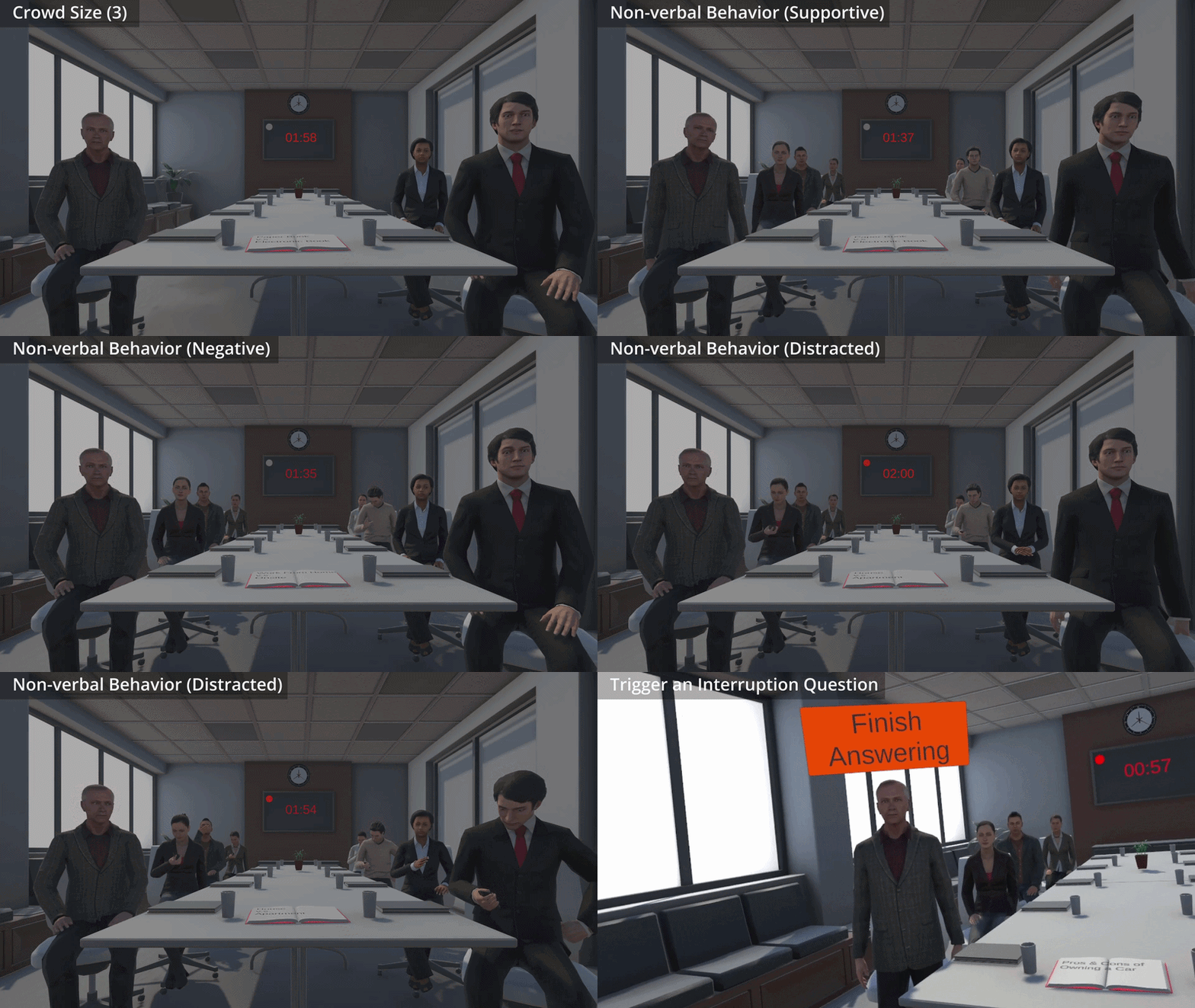
Training Under Pressure: Designing and Evaluating a Multi-Stressor VR Environment for Public Speaking Training

Zhiyuan (Terry) Wei and Lei Zhang
UIST 2026
Effective public speaking requires performing under stress, yet prior VR training systems primarily focused on reducing anxiety rather than building the resilience to withstand it. In this paper, we introduce a multi-stressor VR public speaking training system that combines audience non-verbal behavior, crowd size, and AI-generated contextual Q&A, each designed across manipulable levels of stress.
Thumbnail for Empowering Children to Create AI-Enabled Augmented Reality Experiences
Empowering Children to Create AI-Enabled Augmented Reality Experiences

Lei Zhang, Shuyao Zhou, Amna Liaqat, Tinney Mak, Brian Berengard, Emily Qian, Andrés Monroy-Hernández
UIST 2025
We introduce Capybara, an AR-based and AI-powered visual programming environment that empowers children to create, customize, and program 3D characters overlaid onto the physical world. Capybara enables children to create virtual characters and accessories using text-to-3D generative AI models, and to animate these characters through auto-rigging and body tracking. In addition, our system employs vision-based AI models to recognize physical objects, allowing children to program interactive behaviors between virtual characters and their physical surroundings.
Thumbnail for VRCopilot: Authoring 3D Layouts with Generative AI Models in VR
VRCopilot: Authoring 3D Layouts with Generative AI Models in VR

Lei Zhang, Jin Pan, Jacob Gettig, Steve Oney, Anhong Guo
UIST 2024
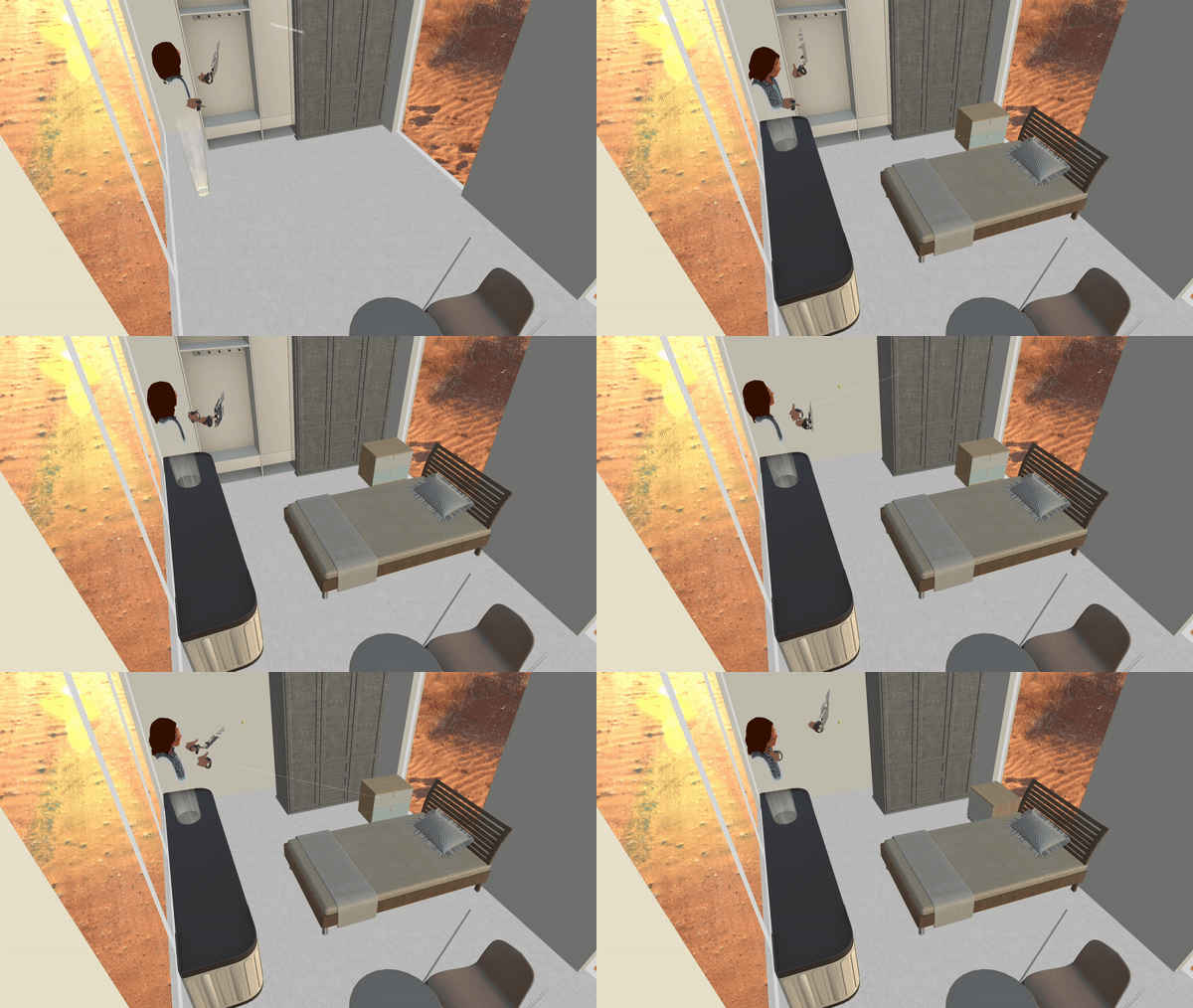
We introduce VRCopilot, a mixed-initiative system that integrates pre-trained generative AI models into immersive authoring, to facilitate human-AI co-creation in VR. VRCopilot presents multimodal interactions to support rapid prototyping and iterations with AI, and intermediate representations such as wireframes to augment user controllability over the created content. We evaluated manual, semi-automatic, and fully automatic creation, and found that semi-automatic creation with wireframes enhanced the creation experience and user agency compared to fully automatic approaches.
Thumbnail for Jigsaw: Authoring Immersive Storytelling Experiences with Augmented Reality and Internet of Things

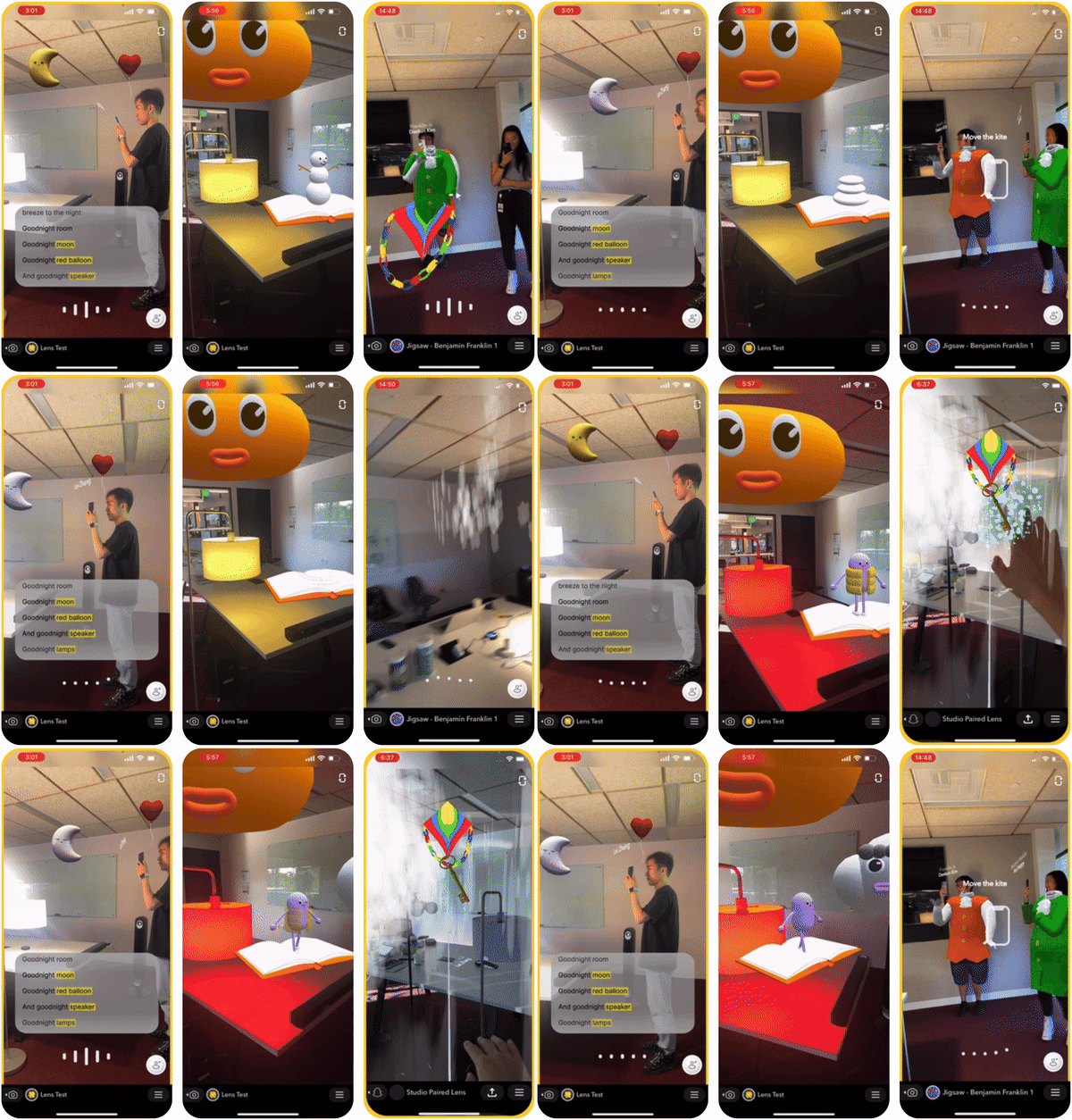
Jigsaw: Authoring Immersive Storytelling Experiences with Augmented Reality and Internet of Things
Lei Zhang, Daekun Kim, Youjean Cho, Ava Robinson, Yu Jiang Tham, Rajan Vaish, Andrés Monroy-Hernández
CHI 2024
We introduce Jigsaw, a system that enables novices to both consume and create immersive stories that harness virtual and physical augmentations. Jigsaw achieves this through the novel fusion of mobile AR with off-the-shelf Internet-of-things (IoT) devices. We evaluated the consumption and creation of immersive stories through a qualitative user study with 20 participants, and found that end-users were able to create immersive stories and felt highly engaged in the playback of three stories. However, sensory overload was one of the most notable challenges across all experiences.
Thumbnail for VRGit: A Version Control System for Collaborative Content Creation in Virtual Reality
VRGit: A Version Control System for Collaborative Content Creation in Virtual Reality

Lei Zhang, Ashutosh Agrawal, Steve Oney, Anhong Guo
CHI 2023
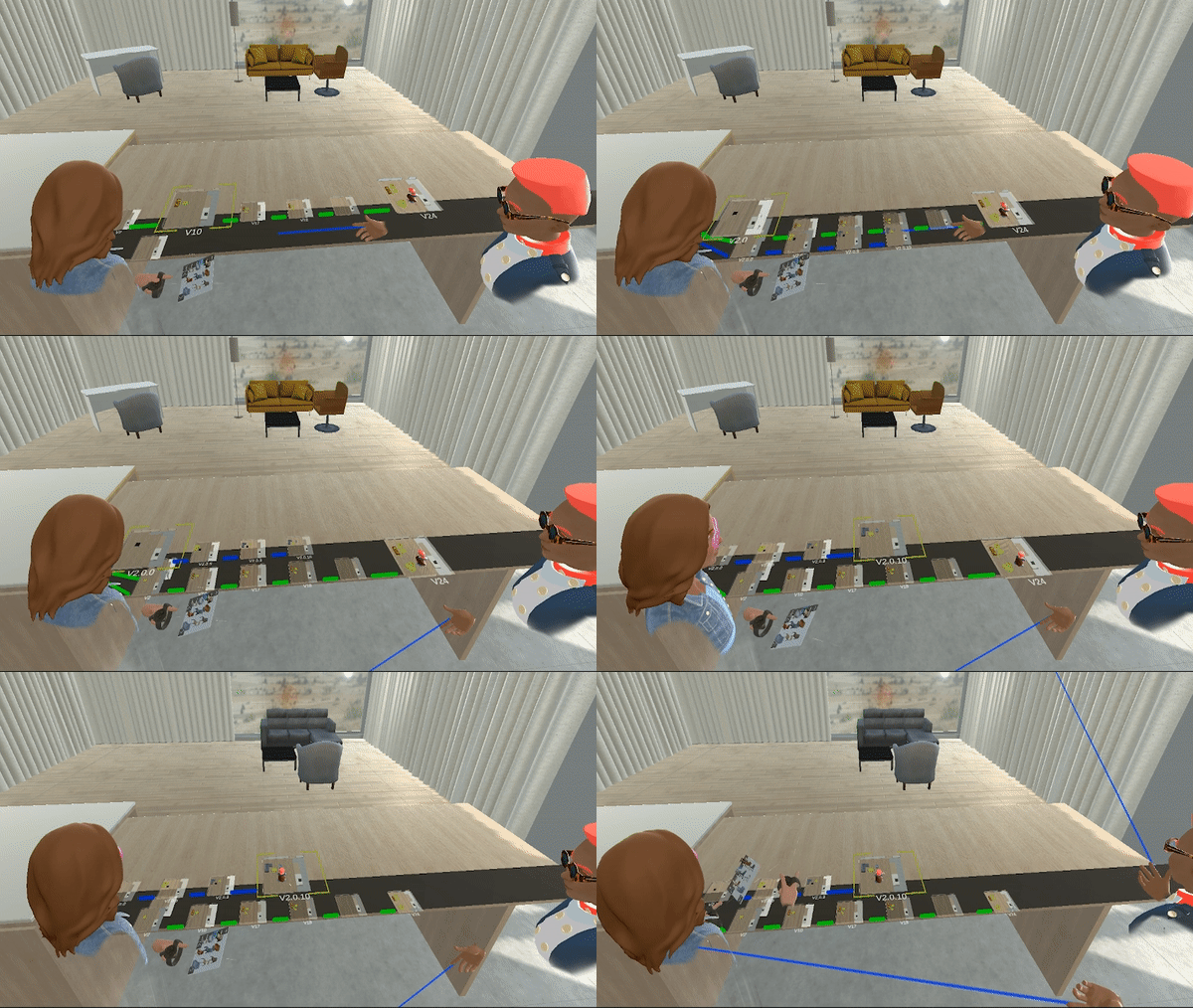
We introduce VRGit, a new version control system for collaborative content creation in VR. VRGit enables novel visualization and interactions for version control commands such as history navigation, commits, branching, previewing, and re-using. VRGit is also designed to facilitate real-time collaboration by providing awareness of users’ activities and version history through concepts of portals and shared history visualizations.
Thumbnail for Auggie: Encouraging Effortful Communication through Handcrafted Digital Experiences

Auggie: Encouraging Effortful Communication through Handcrafted Digital Experiences

Lei Zhang*, Tianying Chen*, Olivia Seow*, Tim Chong, Sven Kratz, Yu Jiang Tham, Andrés Monroy-Hernández, Rajan Vaish, and Fannie Liu
CSCW 2022 (🏆 Best Paper Award)
Digital communication is often brisk and automated. From auto-completed messages to “likes,” research has shown that such lightweight interactions can affect perceptions of authenticity and closeness. On the other hand, effort in relationships can forge emotional bonds by conveying a sense of caring and is essential in building and maintaining relationships. To explore effortful communication, we designed and evaluated Auggie, an iOS app that encourages partners to create digitally handcrafted Augmented Reality (AR) experiences for each other.
Thumbnail for FlowMatic: An Immersive Authoring Tool for Creating Interactive Scenes in Virtual Reality

FlowMatic: An Immersive Authoring Tool for Creating Interactive Scenes in Virtual Reality

Lei Zhang and Steve Oney
UIST 2020
In this paper, we introduces FlowMatic, an immersive authoring tool that raises the ceiling of expressiveness by allowing novice programmers to specify reactive behavior.
Thumbnail for Studying the Benefits and Challenges of Immersive Dataflow Programming

Studying the Benefits and Challenges of Immersive Dataflow Programming

Lei Zhang and Steve Oney
VL/HCC 2019 (🏆 Best Short Paper Award)
In this paper, we study the benefits and challenges of immersive dataflow authoring, a paradigm that allows users to build VR applications using dataflow notation while immersed in the VR world.
© Lei Zhang 2026 — Built with ❤️‍🩹